
MR-F-DIO4/2S Modbus RTU
Description
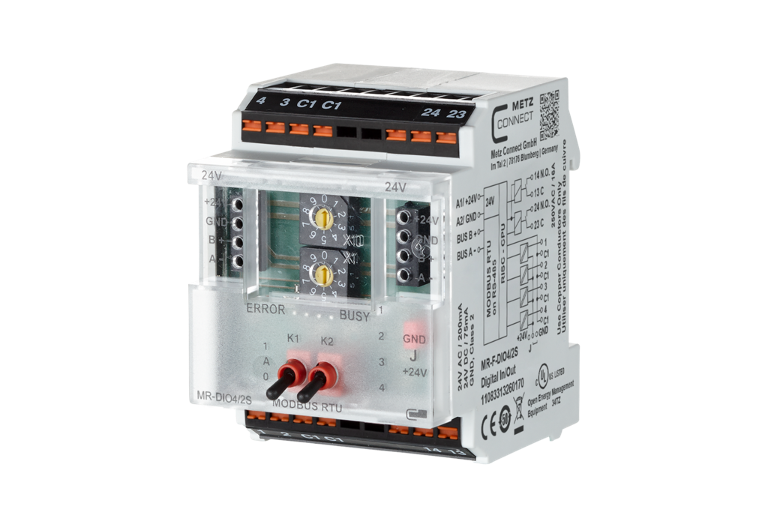
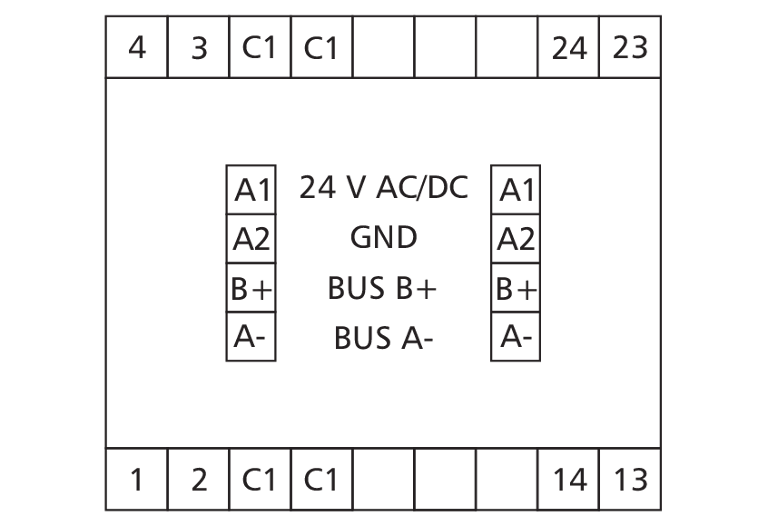
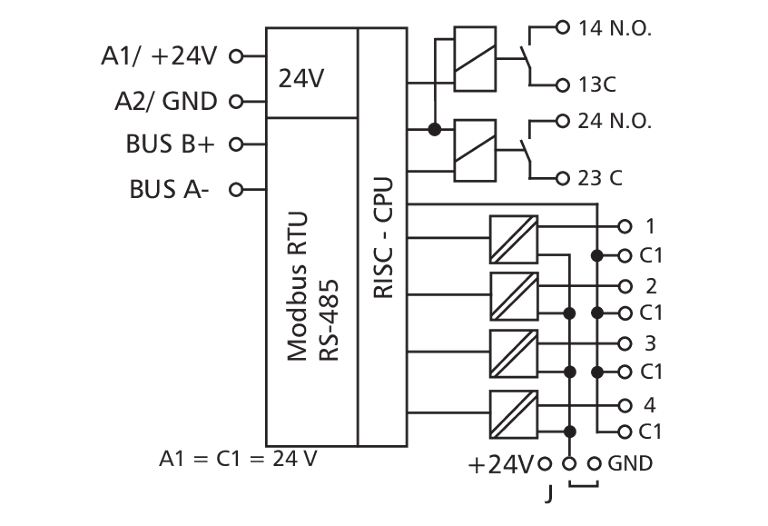
The Modbus module with 4 digital inputs and 2 relay outputs with manual control was developed for decentralized switching tasks. It is suitable for accommodating, for example, light switches and window contacts in a room, switching 2 light strips or controlling louvers. It can also be used to control 2 motorized fire dampers. In this case it is necessary to protect the relay contacts by appropriate load-dependent measures. The inputs can be used as contact or voltage inputs. The inputs and outputs can be switched and scanned by means of standard registers via a Modbus master. Module address, bit rate and parity are set with 2 rotary switches on the front or by software. Suitable for decentralized mounting on DIN TH35 rail according to IEC 60715 in electrical distribution cabinets.
- Connection with spring clamp terminal blocks (push-in)

Technical Data
General Data
Modbus RTU
00 to 99
RS485 (two-wire bus)
1200 to 115200 bit/s
24 V AC/DC +/- 10 % (SELV)
80 mA (AC) / 40 mA (DC)
100 %
4 x digital
30 V AC/DC
more than 7 V AC/DC
2 NO contacts (DPST-NO)
250 V AC
16 A / relay
160 A (less than 20 ms)
Green, red and yellow LED
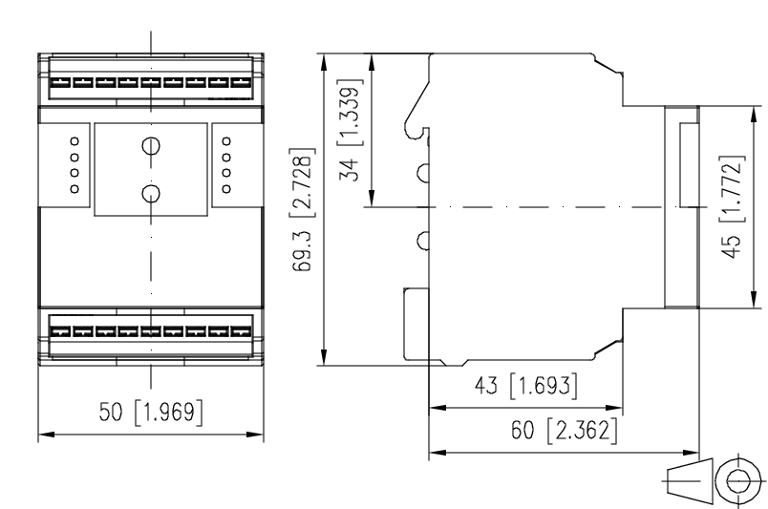
50 x 69.3 x 60 mm
126 g
-5 °C to 55 °C
-20 °C to 70 °C
IP40 / IP20
Check US distributor inventory
Accessories
Part number
11083313260170
4251394610115
Downloads
- Data sheet
- Brochure (Data logger)
- Brochure (Modbus Gateway - Network connection of Modbus RTU fieldbus components)
- Brochure (Modbus RTU components)
- REACh Statement
- 3D-Data - Registration required -
- Mounting note (Safety Instructions multilingual )
- Mounting note (110833132601, 11083313260170)
- Software manual (Modbus Software-Handbuch)
FAQ's
What is the difference between the MR-DIO4/2 and MR-DIO4/2S?
The MR-DIO4/2 has 2 changeover contacts (switch-on current 80 A, less than 20 ms) and the MR-DIO4/2S has 2 NO contacts (switch-on current 160 A, less than 20 ms).
What can I do if the red ERROR LED on the module lights up or there is no communication?
There are several possible causes, please check the following:
- Operating voltage (A1 / A2) connected and sufficient for the device.
- BUS (A- / B+) connected and not reversed. Pay attention to (- / +), not to A/B.
- Address (rotary switch) set correctly, must not occur twice or be 0.
- Bit rate and parity (rotary switch) set correctly, only possible in programming mode (see mounting note).
- Shielded and twisted cable used.
- Termination resistor (120 Ω) set on both sides.
- Bias resistors available once on the BUS.
- Timeout high enough for all participants to respond (approx. 10 ms).